
Morocco Eco-Luxury Hotels
eco-Luxury Morocco Holidays, Mindfully Tailored Around You
From the intricately preserved courtyards of Marrakech's ancient riads and the sweeping, low-impact desert camps of the Agafay, to the wind-swept Atlantic coastline of Essaouira and the rugged, timeless villages of the High Atlas Mountains—Morocco offers an extraordinary canvas for deep, intentional travel.
We design seamless, multi-region itineraries that avoid the breathless pace of standard tourism. By prioritising longer stays and slow overland transit, we ensure your transition between the kinetic energy of the souks and the profound stillness of the mountains is deeply restorative.
Morocco, Designed Through a More Considered Lens
Often celebrated as a gateway where Mediterranean, African, and Arab cultures beautifully converge, Morocco is a sensory masterpiece of architecture, craft, and landscape. However, true luxury lies in experiencing this vibrant nation without contributing to the pressures of over-tourism or cultural commodification.
Our approach to travel design in Morocco goes beyond minimising harm; we seek active regeneration. Every journey we curate is built upon a careful selection process. We partner exclusively with independent boutique riads, eco-lodges, and private wilderness camps that act as long-term stewards of their environments.
By collaborating directly with local Amazigh mountain guides, women-led agricultural cooperatives, and heritage historians, we ensure that your presence directly supports community equity, water conservation, and cultural preservation.
Responsibility is our structural baseline—luxury is the natural result.
Handpicked Sustainable Luxury Riads & Eco-Lodges in Morocco
Every property within our Moroccan portfolio has been rigorously vetted for architectural integrity, genuine carbon-mitigation strategies, and transparent community investment. We look past the aesthetic surfaces to ensure your stay actively preserves the local ecosystem.
Explore Morocco in More Depth: Regions, Culture, and Conservation
Where travel meets purpose
The Anatomy of Moroccan Architecture: Choosing Your Sanctuary
When planning a high-end journey through Morocco, selecting where you rest is as vital to the narrative of your trip as the itinerary itself. Moroccan hospitality is deeply intertwined with history, ancestral craftsmanship, and regional geography.
Rather than relying on generic star ratings, we curate accommodations based on architectural integrity, historical preservation, and a deep sense of place. Below, we break down the distinct forms of luxury Moroccan dwellings—from hidden urban oases to fortified earthen citadels—and how they shape your travel experience.
Urban Oases: Riads vs. Dars
In the labyrinthine hearts of Morocco’s ancient medinas (Marrakech, Fes, and Rabat), historic homes have been meticulously restored into intimate boutique sanctuaries. While the terms are often used interchangeably, their architectural footprints offer entirely different atmospheres.
Riads: The Ornate Courtyard Palaces
Derived from the Arabic word for garden (riyad), a true Riad is a grand private residence or palace built strictly around a central, open-air garden or courtyard, typically divided into four quadrants with a tranquil fountain at its center.
Windows face inward to maximise family privacy and provide natural thermal cooling. For the luxury traveller, a restored Riad offers a masterful showcase of zellige geometric tiling, hand-carved stucco (stuc), and fragrant cedarwood, tucked away behind completely unassuming street walls.
- Our Vetted Curations: Royal Mansour (Marrakech), La Sultana (Marrakech), Villa Mabrouka (Tangier).
- Best For: Travellers seeking dramatic heritage architecture, immersive urban romance, and high-end hotel amenities like private subterranean hammams and rooftop plunge pools.
Dars: The Intimate Private Villas
A Dar translates simply to "house." While it also centres around an internal courtyard, a Dar is typically smaller in scale than a Riad and features an open, tiled atrium rather than a planted garden.
What a Dar lacks in palatial scale, it compromises with unparalleled intimacy and a serene, residential energy. Because of their smaller footprint, high-end Dars feel like private, exceptionally styled homes rather than hotels.
- Our Vetted Curations: Dar Zemora (Marrakech).
- Best For: Multigenerational families, small groups, or travelers celebrating milestones who wish to execute a "private buyout" of a beautifully styled property for an exclusive, fully staffed estate experience.
Regional Fortresses: Kasbahs vs. Ksours
As you cross the High Atlas Mountains and descend toward the fringes of the Sahara Desert, the architecture transitions from delicate urban plaster to monumental earthen structures designed to withstand both climates and ancient conflicts.
Kasbahs: The Fortified Citadels
A Kasbah is a fortified castle or stronghold that historically served as the private residence for local rulers, chieftains, or defensive garrisons. Characterised by thick, towering walls made of pisé (rammed earth) or local stone, dramatic angular watchtowers, and grand defensive gates, staying in a converted luxury Kasbah feels like stepping into a living museum.
Modern eco-luxury conversions capitalise on their commanding hilltop or oasis positions to offer breathtaking, panoramic vistas over valley floors or mountain peaks.
- Our Vetted Curations: Kasbah Tamadot (High Atlas Mountains), Dar Ahlam (Skoura Oasis).
- Best For: High-altitude mountain trekking bases, dramatic desert-fringe stopovers, and travelers who value historic preservation balanced with expansive natural landscapes.
Ksours: The Living Desert Enclaves
A Ksar (plural: Ksour) is an entire fortified earthen village. Unlike a Kasbah—which is a single castle for a ruler—a Ksar is a complete walled community containing communal granaries, marketplaces, mosques, and multiple domestic dwellings (and sometimes several smaller kasbahs within its walls).
In conscious luxury tourism, select properties adopt the layout of a traditional Ksar, utilizing sustainable, hyper-local mud-brick architecture to create a village-like flow of interconnected buildings that respect ancestral Berber design.
- Our Vetted Curations: Ksar El Kabbaba (Skoura).
- Best For: Immersive cultural depth, off-the-beaten-path desert exploration, and travelers dedicated to supporting communities located near fragile UNESCO World Heritage sites like Aït Benhaddou.
Navigating Luxury and Nuance in Moroccan Hospitality
True luxury in Morocco is diverse. It spans from the highly structured, ultra-polished grand resorts of Marrakech to the raw, breathtaking exclusivity of a private luxury tented camp under the Saharan stars.
To help you align your personal travel style with Morocco's distinct lodging landscape, we look at the destination through a highly contextual lens:
Authenticity Over Standardisation:
A masterfully restored, independently owned Riad or Kasbah often delivers an experiential luxury that far outshines standard five-star hotels.
The value lies in the human touch: private hosts who arrange hyper-local medina access, hyper-seasonal cuisine sourced from neighboring market gardens, and architectural histories you can feel.
The Geography of Pricing:
Marrakech operates as a world-class luxury hub, commanding premium rates on par with major European capitals, especially during peak seasons (Spring and Autumn).
Secondary regions, historical oases, and coastal towns offer incredible, slow-travel value, allowing for deeper immersion and longer, more intentional stays.
Modern Amenities vs. Heritage Preservation:
Historic medina properties are architectural treasures, which means layouts are uniquely organic and occasionally compact.
If expansive manicured grounds, Olympic-sized swimming pools, and extensive fitness centers are non-negotiable for your wellness routine, we seamlessly balance your itinerary by pairing intimate heritage stays with world-class resort properties.
The Terroir of Morocco: A Regional Culinary Journey
Moroccan gastronomy is not merely a collection of complex spices; it is a living archive of geography, climate resilience, and rich cultural heritage. From the delicate, Andalusian-influenced court cooking of the northern Imperial cities to the rugged, preservation-led food systems of the High Atlas, the food changes dramatically with the landscape.
By steering away from commercialised, tourist-flattened menus, we introduce you to the authentic flavours of Morocco's four distinct culinary terroirs.
Fes & the Northern Imperial Heart: Imperial Refinement
Influenced heavily by the influx of Andalusian refugees and historical royal courts, the cuisine of Fes and Meknes represents the pinnacle of intricate flavor layering—celebrating the delicate tension between sweet and savory.
The Signature Entities:
- Pastilla (B'stilla): A majestic festive pie composed of paper-thin sheets of warka pastry, traditionally wrapping slow-cooked spiced pigeon (or shredded chicken), saffron, and soft eggs, elegantly dusted with ground cinnamon and powdered sugar.
- Taktouka & Zaalouk: A medley of cooked vegetable starters that open a traditional meal, showcasing the northern Mediterranean climate's rich tomato, smoked bell pepper, and roasted eggplant harvests.
The Atlantic & Mediterranean Coastline: The Marine Bounty
Stretching across 3,000 kilometers of coastline from the wind-swept ramparts of Essaouira to Tangier, coastal Moroccan food is fundamentally shaped by the daily catch and vibrant marine ecosystems.
The Signature Entities:
- Fish Chermoula Tagine: Freshly caught sea bream, turbot, or sardines marinated in chermoula—a pungent, vibrant paste of fresh coriander, parsley, garlic, cumin, paprika, and cold-pressed olive oil—slowly simmered with seasonal root vegetables over charcoal.
- Essaouira Wild Sardines: Simply grilled over open-air coals straight from the wooden fishing trawlers, highlighting Morocco's status as a global standard-bearer for sustainable small-pelagic fisheries.
The High Atlas Mountains: Ancestral Amazigh Preservation
In the high-altitude terrains of the Atlas, food has long been dictated by resourcefulness, extreme winters, and semi-nomadic pastoralism. Here, the flavors are hearty, earthy, and intrinsically tied to ancient land stewardship.
The Signature Entities:
- Barley Tagines & Pit-Roasted Méchoui: Slow-cooked stews utilising sun-dried legumes, mountain goat, or lamb, anchored by ancestral grains like barley rather than modern wheat flour.
- Bissara: A dense, deeply warming split-fava bean or pea soup seasoned generously with wild garlic, cumin, and a heavy pour of local mountain olive oil, traditionally eaten at daybreak.
The Souss Valley & Southern Oases: The Desert Edge
Where the river valleys meet the Sahara, the cuisine transitions to mirror ingenious agricultural adaptations. This is the capital of arid-land crops, date-palm conservation, and indigenous forest products.
The Signature Entities:
- Amlou: A luxurious, dense paste crafted from stone-ground toasted almonds, wild orange-blossom honey, and rare culinary Argan oil.
- Tagine lafou (Oasis Tagine): A slow-simmered dish combining dates harvested from ancient khattara (underground irrigation)-fed palm groves with tender meat, infused with Ras el Hanout (a complex blend of up to thirty distinct spices).
Living Heritage: Morocco’s Deepest Cultural Festivals
To truly understand Morocco, one must experience the rhythms of its living traditions. Across the year, the country comes alive with historic gatherings —ranging from ancestral nomadic reunions to sacred musical celebrations.
Morocco's Festivals
We curate journeys that allow you to engage with these powerful cultural milestones authentically and respectfully, ensuring your presence honours and preserves the intangible heritage of the communities you visit.
Here are five of Morocco’s most profound cultural festivals.
Imilchil Marriage Festival
When: September
Where: Deep in the lake plateau of the High Atlas
About: The Ait Ya’za tribe gathers for a historic three-day convergence.
Born from a legendary, star-crossed love story between two youth from rival tribes, this festival is a vital social mechanism.
It allows semi-nomadic families from isolated mountain valleys to reunite, celebrate marriages, trade livestock, and preserve ancient Amazigh songs, poetry, and traditional dress.
The Considered Footprint: This is a sacred community event, not a performance. We arrange for clients to visit discreetly with private local guides, staying in low-impact mountain lodges and ensuring tourist photography does not disrupt the solemnity of the tribal courtships.
Gnaoua Festival
When: June
Where: Essaouira
About: A deeply spiritual, hypnotic art form brought north by enslaved sub-Saharan Africans centuries ago.
The festival celebrates the Maâlems (master musicians) who combine acrobatic dancing, lyrical poetry, and the deep, resonant resonance of the guembri (a three-stringed lute) to induce a state of spiritual healing.
The Considered Footprint: This festival has single-handedly revitalised the creative economy of Essaouira. We secure private rooftop access overlooking the rampart stages, allowing you to witness this UNESCO-listed heritage away from the dense street crowds.
Fes Festival of World Sacred Music
When: Early Summer
Where: Fes
About: This world-renowned festival turns the entire medieval medina of Fes into an open-air sanctuary for interfaith dialogue.
For one week, Sufi chanters, swirling dervishes, and sacred musicians from every major global faith tradition perform under ancient banyan trees in the palace courtyards, celebrating the historic tolerance and spiritual depth of Morocco's intellectual capital.
The Considered Footprint: The festival supports the physical preservation of Fes’s delicate architectural spaces. We pair this experience with stays in independent, historic riads within the old city to ensure your investment stays entirely local.
Tan-Tan Moussem
When: June
Where: Sahara
About: Recognised by UNESCO as a Masterpiece of the Intangible Heritage of Humanity, the Tan-Tan Moussem is an extraordinary annual gathering of over thirty nomadic tribes from across the Sahara and Northwest Africa.
Originally a trading outpost, it is a vibrant celebration of desert culture, featuring dramatic camel races, poetry competitions, Fantasia horse charges (tbourida), and traditional storytelling around desert campfires.
The Considered Footprint: Located in Southwest Morocco, visiting this region embodies the philosophy of slow travel, taking you entirely off the beaten path and directly supporting the preservation of vulnerable nomadic ways of life.
Rose Festival
When: May
Where: High Atlas, Kelaat M'gouna
About: The Valley of the Roses at the base of the High Atlas smells entirely of perfume.
To celebrate the annual harvest of the Persian rose (Rosa damascena), the town of Kelaat M'gouna hosts a vibrant festival. Petals are harvested by local women at dawn, showered over streets, and distilled into precious oils.
The Considered Footprint: The rose industry is a vital driver of economic independence for women in the southern valleys. We curate visits that bypass mass commercial souvenir shops, taking you directly into vetted, ethical agricultural cooperatives where fair-trade practices are guaranteed.
Honouring morocco's Ancestral Mastery
Long before the word “artisan” became a modern marketing buzzword, Morocco was perfecting the ultimate expression of slow, intentional creation. The extraordinary tactile beauty of Morocco’s interiors and textiles is not the result of mass manufacturing; it is a living art form sustained by a guild system that dates back to the 10th century.
At the apex of this system is the Maâlem—a master craftsman who has dedicated a lifetime, starting with decade-long apprenticeships, to perfecting a single medium.
We design our destination experiences to connect you directly with these master workshops and ethical, women-led cooperatives. By prioritising authenticity over commercial tourist markets, your acquisitions directly fund the preservation of endangered cultural heritage.
Zellige: The Visual Poetry of Geometry
The iconic geometric tilework that adorns Morocco’s most majestic fountains and riads is known as Zellige. True Zellige relies entirely on the unique, iron-free gray clay found exclusively in the valley beds of Fes. The raw clay is kneaded, hand-flattened, sun-dried on rooftops, and fired in ancient wood-burning kilns.
The Maâlem Touch: Once fired, a master artisan uses a heavy, razor-sharp medieval forge hammer called a menkach to cleanly shatter and shape each glaze tile into microscopic geometric components—radiating stars, diamonds, and polygons—entirely by eye and memory, without templates.
The Considered Purchase: True handmade Zellige is defined by its organic irregularities, subtle shade variations, and rough edges. Avoid uniform, perfectly smooth, factory-stamped ceramic imitations sold in commercial stalls, which strip livelihoods from the traditional guilds of Fes.
Handwoven Textiles: The Living Language of Amazigh Women
In the high terrains of the Middle and High Atlas, weaving is an intellectual property owned entirely by Amazigh women. Far from simple decorative floor coverings, traditional rugs are deeply personal visual diaries. Using pure, high-mountain sheep’s wool and wild-harvested natural dyes—such as pomegranate skins, saffron, wild mint, and indigo—weavers knot their life stories, ancestral protection symbols, and tribal histories directly into the textile.
The Maâlem Touch: From the thick, plush, cream-and-charcoal geometric piles of the Beni Ourain tribes designed to withstand high-altitude winters, to the flat-woven, vibrant, lightweight Kilims of the desert fringes, every carpet carries a totally unique dialect.
The Considered Purchase: We guide our guests past aggressive city brokers and connect them directly with vetted, fair-trade Women's Weaving Cooperatives in rural mountain villages. This ensures that 100% of your investment flows directly back to the women who spent months working the looms, supporting female financial independence and rural literacy.
Sacred Ateliers: From Cobalt Ceramics to Pierced Brass
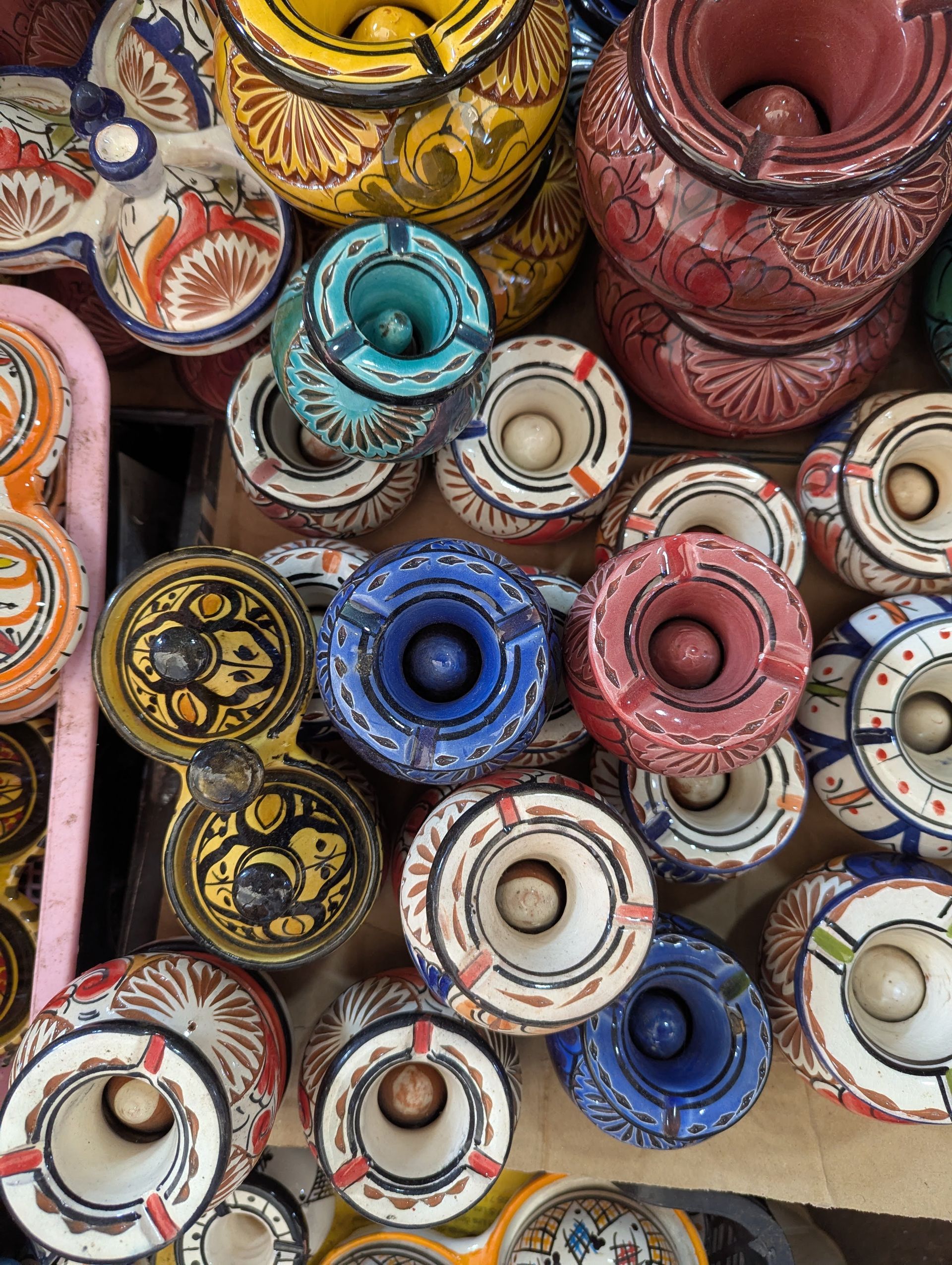
Morocco’s regional geography dictates its material mastery. In the cultural capital of Fes, potters are world-renowned for their delicate, intricate floral arabesques hand-painted in a striking, deep cobalt blue glaze derived from local minerals. In contrast, the seaside capital of Safi is celebrated for its heavy, earth-toned terracotta and vibrant polychrome utility pottery.
The Maâlem Touch: Meanwhile, in the metalworking quarters of Marrakech and Tetouan, brass-smiths practice Dinanderie. Master metalworkers hand-hammer sheets of solid copper and brass, using fine chisels to pierce intricate geometric fretwork into architectural lanterns. When illuminated, these hand-bored perforations throw complex, lace-like constellations of light and shadow across riad walls.
The Considered Purchase: When evaluating metalwork, look closely at the weight and the piercing detail. High-end, genuine masterwork uses solid copper or brass with crisp, hand-cut edges. Avoid lightweight, chemically treated tin replicas that oxidize rapidly and flood commercial tourist markets.
The Moroccan Seasonal Planner
Use our structural calendar matrix to align your personal travel desires with Morocco’s natural rhythms:
| Time of Year | Best Regional Focus | Highlight Experiences |
|---|---|---|
| Mar – May (Spring) | Countrywide: Marrakech, Fes, Atlas Mountains, Sahara Desert. | Wildflowers in the Atlas, almond blossoms, perfectly balanced desert temperatures. |
| Jun – Aug (Summer) | The Elements: Atlantic Coast (Essaouira, Tangier), High-Altitude Peaks. | Coastal trade winds, marine biodiversity, cooling alpine retreats, world music festivals. |
| Sep – Nov (Autumn) | The Valleys: Oasis Regions (Skoura), Imperial Cities, Sahara. | Date harvest season, rural harvest festivals, exceptional lighting for photography. |
| Dec – Feb (Winter) | The South: Deep Sahara Desert, Marrakech City Breaks. | Flawless daytime desert trekking, empty medinas, snow-capped mountain backdrops. |
MOROCCO Quick Guide
Arabic and Amazigh.
French is also widely spoken
Moroccan Dirham (MAD)
Code +212
UTC/GMT
+1
Type C/E (220 Volt, 50 Hz)
3-4 Hours
from the UK
JOIN OUR NEWSLETTER
Experience the world of responsible luxury travel with us by subscribing to our newsletter ‘The Circular’.
Let A’ARU Collective be your trusted companions on a journey that is both enriching and captivating
No spam. We respect your privacy.